Our Muscle Balance approach
I developed our Muscle Balance program to organize the posture, low-back and neck work we use in the clinic. The starting point comes from your assessment. We choose the movements and difficulty for you, explain what to practice, and use phase tests and your response to guide the next step.
How the exercises progress
- STEP 01
Find a manageable starting point
Begin with activities you can tolerate and understand when to stop or ask for help.
- STEP 02
Prepare for movement
Selected soft-tissue work may be included when it fits the plan.
- STEP 03
Work on restricted movement
Use stretching or mobility work for areas identified in the assessment.
- STEP 04
Practice control
Learn to perform the selected movement with the control the task requires.
- STEP 05
Build strength
Increase the challenge when you can manage the current exercise and your symptoms allow.
- STEP 06
Use it in daily life
Practice how the exercise relates to activities such as lifting, reaching or walking.
Progress is based on how you’re doing
Each phase of your corrective exercise program has tests to help determine when you’re ready for the next one. If you cruise through the easier work and pass those tests, we move you forward unless there’s a clinical reason to spend more time there. Your progress depends on how YOUR body responds. We check how you perform the exercises and how you feel during and after them, then adjust the challenge as your body is able. If symptoms change or a task needs more practice, we address that before moving on.
What kinds of concerns do we assess?
Your concerns may involve rounded upper-back posture, pelvic position, neck movement or control through the low back. A visible posture difference does not establish a diagnosis. Dr. Koser considers it alongside your symptoms, movement and examination. We do not offer structural-scoliosis correction.
What about McGill exercises?
Dr. Stuart McGill’s “Big 3” are the modified curl-up, side plank and bird dog. They train the muscles around your trunk to work together, building endurance and control while limiting unwanted movement through the lower back. Squat University’s explanation emphasizes short, repeated holds and good movement quality rather than working to exhaustion.
- EXERCISE 01
Modified curl-up
A small lift of the head and shoulders challenges the front of your trunk while preserving the lower back’s natural curve. The goal is controlled bracing without rounding your low back.
- EXERCISE 02
Side plank
This exercise challenges the muscles along the side of your trunk and hip. A bent-knee version can provide a starting point before progressing to a longer, more demanding position.
- EXERCISE 03
Bird dog
From hands and knees, you practice moving an arm and the opposite leg while keeping your trunk steady. Simpler versions can help you learn the control before combining both movements.
At Optimal Spine, Dr. Koser selects the versions, repetitions and starting difficulty for you. The Big 3 can be part of a broader plan that addresses your movement findings and everyday demands. As you meet the requirements for the next phase, we progress your program.
Alignment
Alignment and posture patterns
We look at how your spine, pelvis, hips and feet work together. These are patterns considered in our exercise program, not diagnoses made from appearance alone. Your examination determines which findings matter.
Thoracic hyperkyphosis
Increased upper-back rounding
An increased upper-back curve may appear alongside forward head posture or rounded shoulders. The exercise plan can focus on upper-back movement, shoulder support and postural endurance.
Lumbar hyperlordosis
An increased lower-back arch
This pathway considers an increased lumbar curve together with pelvic position and hip movement. Work is selected to improve trunk and hip control during the activities that bother you.
Increased sacral base angle
A forward-tilted pelvis
When forward pelvic tilt is a main finding, we assess how the hips, abdominal muscles and glutes share the work. This is considered separately from the overall size of the lower-back curve.
Decreased sacral base angle
A tucked pelvis and flatter lower back
This pattern involves a pelvis that tucks under and a reduced lower-back curve. The program considers hip mobility and trunk endurance so movement can be practiced without forcing a particular position.
Explore 12 more alignment patterns
Stratification pattern
Mixed muscle-balance patterns
Some people show a combination of limited movement, muscle tension and reduced endurance across several regions. The assessment helps decide which areas need mobility, control or strengthening.
Quadruple-loss pattern
Reduced curves across several regions
This catalog pathway considers reduced curves across multiple parts of the spine. Dr. Koser assesses movement and symptoms before selecting regional mobility and support exercises; a straighter appearance alone does not establish a problem.
Thoracic hip shear pattern
Swayback and forward hip shift
The hips may rest forward while the upper body leans back. The exercise focus is on coordinating the rib cage, pelvis and hips during standing and movement.
Gluteal muscle-control pattern
Difficulty using the gluteal muscles
The assessment considers whether the lower back or hamstrings take over during hip movement. Selected exercises practice hip control and gradually build gluteal strength and endurance.
Pseudoscoliosis / functional lateral shift
A right or left lateral shift
The trunk can shift to one side relative to the pelvis. We assess whether the position changes with movement or pelvic support and screen for a fixed structural curve. Structural-scoliosis correction is outside this program.
Lateral pelvic tilt
An uneven pelvic position
One side of the pelvis may sit higher or lower. Dr. Koser checks the side and possible contributors before selecting hip, trunk or balance work; a visible difference does not automatically mean a short leg.
Pelvic rotation pattern
Pelvic rotation asymmetry
The pelvis may rest or move with a rotational bias. The program considers side-to-side hip mobility, trunk control and walking mechanics rather than assuming that every asymmetry needs correction.
Pronation distortion pattern
Foot pronation and inward leg movement
This pathway looks at how arch movement, ankle motion and hip control interact during standing and walking. Exercises are selected from the examination rather than from foot shape alone.
Dynamic knee valgus
The knee moving inward
A knee may move inward during a squat, step or landing. The program considers foot contact, hip strength and movement coordination, then practices those tasks at an appropriate difficulty.
Pes cavus / supination bias
High arches and outer-foot loading
The assessment looks at ankle mobility, foot flexibility and how weight moves through the leg. Exercise focuses on the movement and balance findings that are relevant to you.
Genu recurvatum
Resting in knee hyperextension
This pathway addresses the habit of locking the knees backward during standing or walking when it is relevant to symptoms or control. Work emphasizes balance and coordinated leg support.
Hallux valgus / first-ray function
Big-toe and forefoot control
The program considers big-toe position, forefoot loading and push-off during walking. Exercise may address muscle control and movement; it is not a promise to reverse a bunion or change fixed bone shape.
Neck control
Neck stabilization and endurance
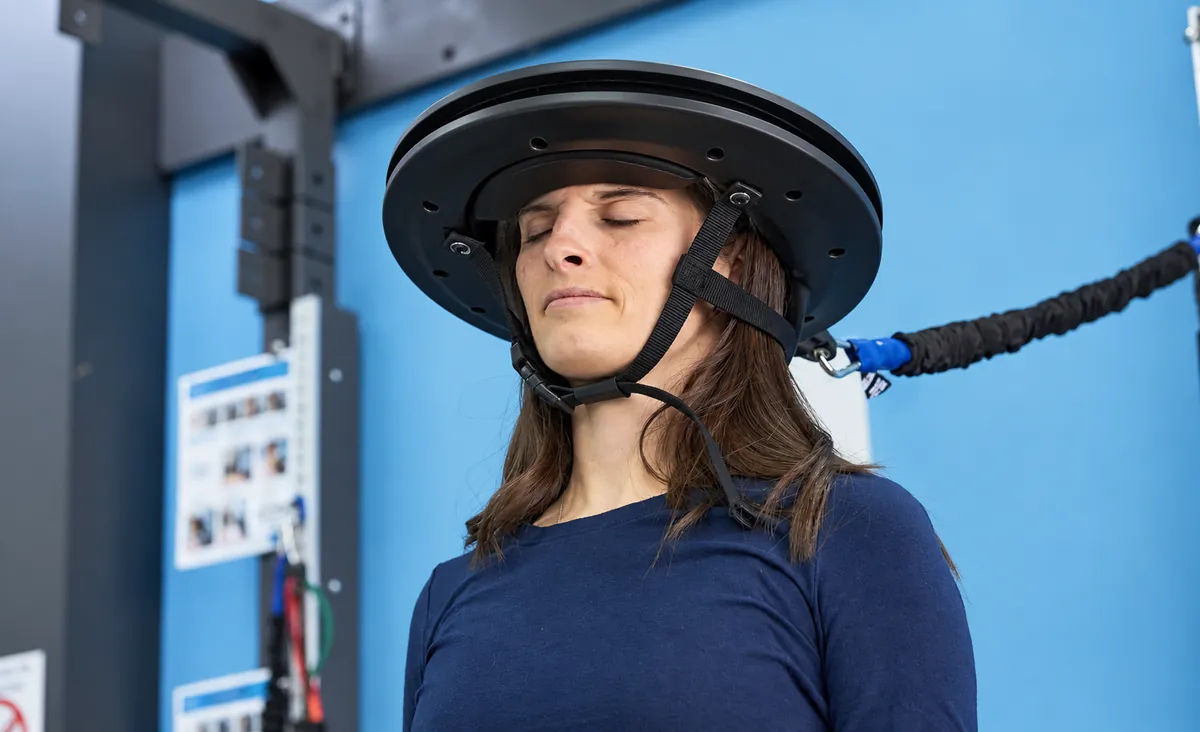
Our cervical series starts with symptom assessment and control without added resistance. Iron Neck or other resistance work is considered only when the starting requirements are met. Neck stabilization exercise is not the same as treating diagnosed cervical instability.
Cervical radiculopathy / disc-related symptoms
Neck disc and arm nerve symptoms
Pain, tingling or strength changes into an arm need nerve assessment. The program prioritizes stable symptoms and comfortable neck control before adding resistance or more demanding movement.
Cervicogenic headache pathway
Neck-related headaches
When the examination supports a neck-related component, exercise may address neck endurance and upper-back support. Headache pattern and dizziness are assessed before loading; this is not a program for every headache or migraine.
Cervicobrachial / neural-sensitivity pathway
Sensitive nerves in the neck and arm
Arm symptoms may change with neck or shoulder position. This series emphasizes comfortable neck control and shoulder support, with any nerve-movement work chosen and monitored by Dr. Koser.
Cervical degeneration / facet arthritis
Neck disc and joint changes
For selected people with neck stiffness or position-sensitive discomfort, the program works on endurance and controlled movement in a tolerable range. Progression depends on symptoms and examination findings.
Cervical muscle control and endurance
Posture-related neck fatigue
This pathway focuses on neck muscles that tire during desk work or other sustained tasks. The plan builds neck and shoulder support, then applies that control to work and everyday movement.
Low-back care
Low-back control and activity tolerance
Our low-back series uses individualized, McGill-based exercise planning. The starting point depends on which movements you tolerate, your nerve findings and your daily demands. A symptom pattern alone does not confirm a diagnosis.
Discogenic-pain pathway
Disc-related or bending-sensitive pain
When sitting or bending is difficult, the plan examines how you move through your hips and trunk. Exercise can focus on tolerable movement and trunk endurance rather than applying the same stretching routine to everyone.
Lumbar instability pathway
Low-back movement-control difficulty
Catching or pain during transitions prompts a closer assessment; it does not by itself prove instability. When appropriate, the plan practices trunk control during rolling, standing and lifting.
Canal or nerve-opening narrowing
Spinal stenosis
Some people with stenosis have leg discomfort or heaviness when standing or walking. Exercise is selected to build tolerable activity and function; it is not a promise to reverse the narrowing.
A vertebra slipping relative to the one below
Spondylolisthesis
A diagnosed slip needs an individual assessment before exercise or hands-on care. When exercise is appropriate, this series emphasizes controlled movement and trunk and hip endurance, with referral when needed.
Explore 6 more low-back care patterns
SI-joint pathway
Sacroiliac-region pain
Pain around the back of the pelvis can make stairs, rolling or standing on one leg difficult. The assessment guides work on hip support and load transfer; pain location alone cannot confirm an SI-joint diagnosis.
Shear-intolerance movement pattern
Catching with bending or twisting
This program category describes difficulty controlling certain movements rather than a stand-alone diagnosis. Work may include coordinated lifting, trunk endurance and gradual practice of the tasks that provoke symptoms.
Lumbar facet-joint changes
Lower-back joint stiffness
Some people have stiffness or discomfort when arching or turning. The plan considers comfortable movement, hip mobility and trunk support, then adjusts to how you respond.
Flexion-intolerant athlete pathway
Bending-sensitive training
For lifters or athletes bothered by rounding or bending under load, the plan reviews technique, training demands and current tolerance. Exercise progresses toward the movements required for your sport.
Extension-intolerant athlete pathway
Arching-sensitive training
Overhead work or other training may be uncomfortable when the lower back arches. This pathway works on trunk and hip coordination and a gradual return to the relevant activity.
Desk-work and daily-activity pathway
Long sitting days and returning to movement
This series considers movement breaks, hip and upper-back mobility and transitions such as getting out of a chair. The plan is adapted to your workday and the activities you want to resume.
Cervical strength and control
Our neck-exercise pathway starts with your examination findings. The photo shows a clinic team member demonstrating our Iron Neck equipment. Dr. Koser determines whether this kind of exercise belongs in your plan and selects the starting point and progression for you.
What about cervical instability?
Cervical instability is different from ordinary neck stiffness or muscle fatigue. If you’ve been diagnosed with instability or are concerned about it, tell Dr. Koser and bring any relevant specialist and imaging reports. Treatment depends on the cause and may require specialist care. Neck exercises and chiropractic adjustments aren’t automatically appropriate for an unstable neck.
How this differs from Optimal Fitness
Clinical corrective exercise is selected as part of your care at Optimal Spine Chiropractic. Optimal Fitness is a separate business inside the clinic, offering full-body strengthening using a scientific approach and lifestyle-based weight-loss support. Its coaching is a separate choice.

Before you visit
Your questions, answered.
Do I need to be fit before starting?
Tell us your starting point and what you find difficult. The plan should begin with tasks appropriate for you.
Will I have exercises to do at home?
Dr. Koser discusses what to practice between visits and provides instructions. Tell us if an exercise bothers you or the instructions aren’t clear.